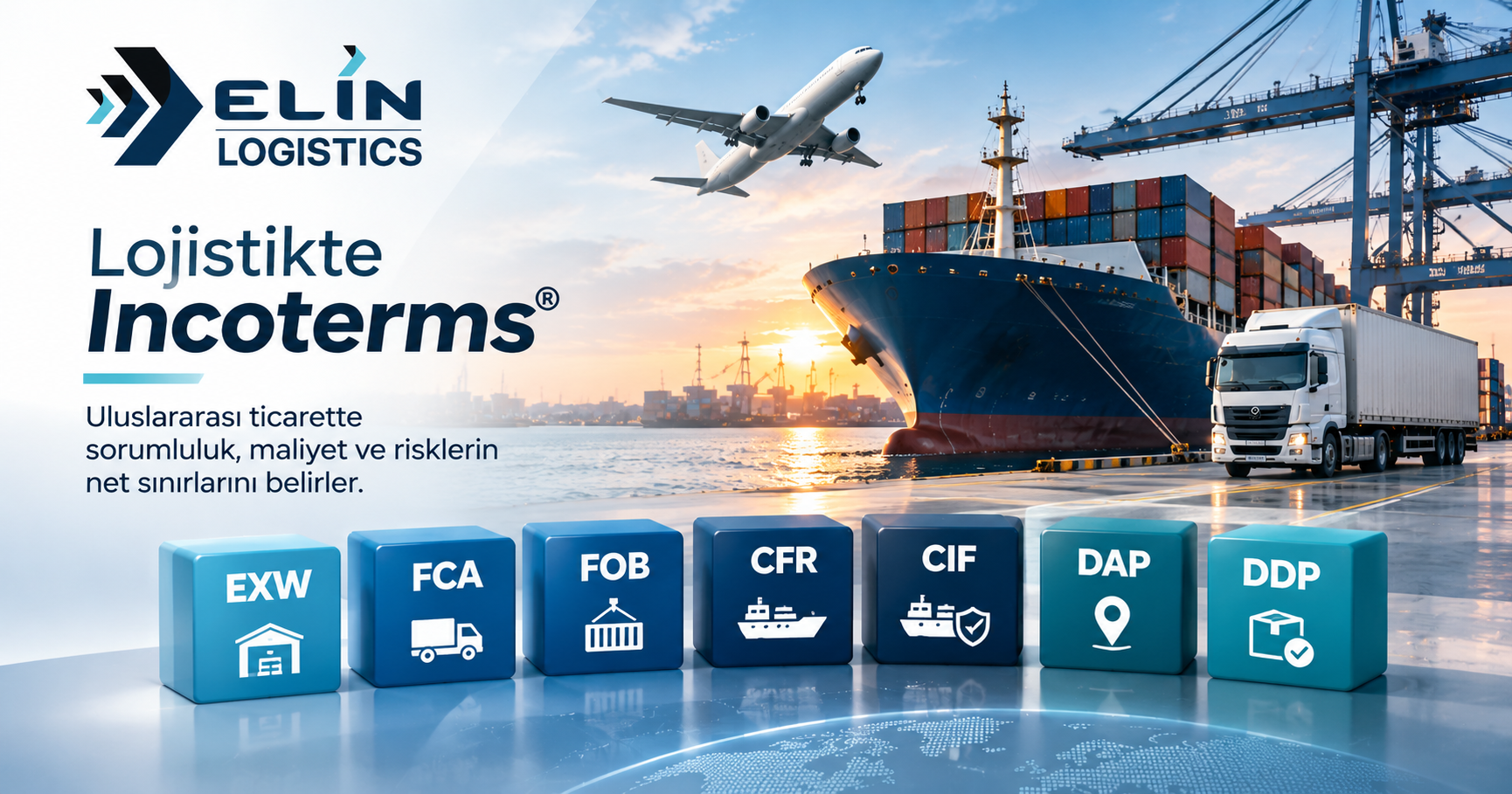
What are Incoterms? Incoterms are standard delivery rules published by the International Chamber of Commerce (ICC) that define, in an international sale, where the goods are delivered, at what point the risk passes to the buyer, and who pays which costs. The current version is Incoterms 2020, which came into force on 1 January 2020 and contains 11 rules. Choosing the right rule makes it clear from the outset who arranges the freight, who handles customs clearance and who bears the loss if the cargo is damaged in transit. In this guide, we bring all 11 rules together in one table, explain the most commonly used ones with examples and share the mistakes we see most often in practice.
What do Incoterms cover, and what don't they?
When you write "FOB Ningbo, Incoterms 2020" in a sales contract, the parties' obligations become clear on these points:
- Delivery point: Where and how the seller is considered to have delivered the goods.
- Transfer of risk: The moment at which the risk of loss of or damage to the goods passes to the buyer.
- Allocation of costs: Who pays for loading, main carriage, insurance, unloading and other costs.
- Customs formalities: Who carries out export and import customs clearance.
Incoterms do not determine when ownership of the goods passes, the payment method (advance payment, letter of credit, documentary collection), the sale price or the remedies for breach of contract. These must be set out separately in the sales contract. Using an Incoterm as if it were a payment term is a common mistake.
The 11 rules of Incoterms 2020
The rules fall into two groups: seven can be used for any mode of transport, and four are only for sea and inland waterway transport (ICC). Under all rules except EXW, the seller handles export clearance; under all rules except DDP, the buyer handles import clearance.
| Rule | Transport mode | Where risk passes to the buyer | Main carriage paid by | Insurance obligation |
|---|---|---|---|---|
| EXW (Ex Works) | Any | Seller's premises, goods at the buyer's disposal, not loaded | Buyer | None |
| FCA (Free Carrier) | Any | Place where goods are handed to the buyer's carrier | Buyer | None |
| CPT (Carriage Paid To) | Any | Handover to the first carrier at origin | Seller | None |
| CIP (Carriage and Insurance Paid To) | Any | Handover to the first carrier at origin | Seller | Seller, broad cover (ICC A) |
| DAP (Delivered at Place) | Any | At destination, on the arriving vehicle, ready for unloading | Seller | None |
| DPU (Delivered at Place Unloaded) | Any | At destination, unloaded | Seller | None |
| DDP (Delivered Duty Paid) | Any | At destination, cleared for import, ready for unloading | Seller | None |
| FAS (Free Alongside Ship) | Sea | Alongside the vessel at the port of shipment | Buyer | None |
| FOB (Free on Board) | Sea | On board the vessel at the port of shipment | Buyer | None |
| CFR (Cost and Freight) | Sea | On board the vessel at the port of shipment | Seller | None |
| CIF (Cost, Insurance and Freight) | Sea | On board the vessel at the port of shipment | Seller | Seller, minimum cover (ICC C) |
You can also find short explanations and a comparison of the rules in our Incoterms 2020 tool.
What do the most commonly used rules mean?
EXW: The rule with the fewest obligations for the seller. The goods are made available to the buyer at the seller's warehouse; loading, export clearance and all transport are the buyer's responsibility. The price that looks cheapest on paper is often the EXW price, but you or your forwarder must handle all formalities in the country of origin.
FCA: The seller clears the goods for export and hands them over to the carrier nominated by the buyer. If the place of delivery is the seller's premises, the seller also loads the goods. Since the buyer arranges the main carriage, the buyer controls transport and destination costs. Because it can be used for any mode of transport, it is the most practical rule for container, air and road shipments. Under Incoterms 2020, in letter of credit transactions, the buyer can also instruct its carrier to issue a bill of lading with an on-board notation to the seller.
FOB: The best-known rule in Turkey. The seller loads the goods on board the vessel at the port of shipment, risk passes to the buyer at that moment, and the buyer pays the freight. It is for sea transport only.
CFR and CIF: The seller pays the freight to the port of destination, and under CIF also takes out insurance. However, as with FOB, risk passes to the buyer when the goods are loaded on board at the port of shipment.
DAP: The seller brings the goods to the address named by the buyer; unloading and import clearance are the buyer's responsibility. It is commonly used for purchases from Europe by road.
DDP: The rule with the most obligations for the seller. The seller delivers the goods after clearing them for import and paying the duties and taxes. We explain separately below why it should be used with care for imports into Turkey.
Two critical points in the C rules: cost and risk end in different places
Under CPT, CIP, CFR and CIF, the seller pays the freight up to the destination, but risk passes to the buyer at the point of origin. For example, if a container you buy on CIF terms from Shanghai to Mersin is damaged while the ship is in the Indian Ocean, the loss is yours, even though the seller paid the freight. That is why, under the C rules, buyers should know that the risk is theirs while the cargo is in transit, and check the insurance cover accordingly.
Is the insurance the same under CIF and CIP?
No. Incoterms 2020 made the difference in insurance between the two rules clear (ICC):
- CIF: The seller must take out insurance with minimum cover (Institute Cargo Clauses C). This cover applies to major casualties such as fire, sinking and collision; common risks such as theft, water damage or handling damage are generally not covered.
- CIP: The seller must take out insurance with broad cover (Institute Cargo Clauses A, "all risks").
Under both rules, the insured amount must be at least 110% of the contract value. The parties may agree on a different level of cover in the contract. If you are shipping valuable cargo bought on CIF terms, consider taking out additional insurance.
Why can DDP be problematic for imports into Turkey?
Under DDP, the seller handles import clearance and pays the duties and taxes. For imports into Turkey, this creates two problems:
- The declarant: Under Article 62 of the Turkish Customs Law, if registering a declaration imposes specific obligations on a particular person, the declarant must be established in the Turkish customs territory (Turkish Customs Law, Articles 58–72). This makes it difficult in practice for a foreign seller without a company in Turkey to import in its own name.
- VAT deduction: If the import declaration is not issued in your company's name, you cannot deduct the import VAT paid, and you will not have a purchase document for the goods.
Door-to-door services with duties included that are offered in the industry under the name "DDP" are not the same as the DDP rule in Incoterms. We explain this in detail in our China to Turkey shipping guide. If you are going to sell the goods, we recommend a set-up in which the declaration is issued in your company's name.
Do Incoterms affect customs duty?
The rule you choose does not change the base on which customs duty is calculated. Under Article 27 of the Turkish Customs Law, transport and insurance costs up to the port or place of entry into Turkey are added to the customs value of imported goods (Turkish Customs Law, Articles 23–31). This means that for EXW or FOB purchases, freight and insurance not shown on the invoice are added to the value at customs, and duty is calculated on that amount. When comparing EXW and FOB prices with CIF prices, you should therefore also take freight and insurance into account. You can find a worked cost example in our guide to importing products for resale.
The most common Incoterms mistakes
- Using FOB for air and road shipments: FOB, CFR, CIF and FAS are for sea transport only. For air and road shipments, use FCA, CPT or CIP.
- Using FOB or CIF for container shipments: A container is handed over at the terminal days before it is loaded on board. During that time, it becomes unclear who bears the risk. For container shipments, the ICC recommends rules such as FCA or CIP.
- Not naming the place precisely: Instead of "FOB China", state the port or address clearly, as in "FOB Ningbo, Incoterms 2020". The version should also be stated.
- Buying EXW without planning for export clearance: Under EXW, export clearance is the buyer's responsibility, but it is difficult for a foreign buyer to handle this in the seller's country. If the seller can clear the goods for export, FCA is more suitable.
- Assuming CIF insurance is enough: Minimum cover does not include most common types of damage.
- Forgetting destination charges on CFR and CIF purchases: The freight paid by the seller ends at the port of destination. Terminal, delivery order and port charges are the buyer's responsibility and can come as a surprise because they do not appear in the supplier's offer.
Which Incoterms rule should you choose?
There is no single right answer; the choice depends on how much control you want over the transport and how much your supplier can take on. Based on our experience in the field:
| Situation | Recommended rule | Why |
|---|---|---|
| Importing from the Far East by container or air | FCA (FOB for bulk or break-bulk sea cargo) | You control freight and destination costs through your own forwarder |
| The supplier cannot handle export formalities | EXW | Your forwarder should take on the formalities at origin |
| Importing from Europe by road | FCA or DAP | With FCA you are in control; with DAP the seller handles transport |
| As an exporter, you want to control the transport | CPT, CIP or DAP | You arrange the freight and give the customer a delivered price |
| As an exporter, your customer wants everything handled | DAP, or DDP if needed | DDP requires a set-up that can import in the destination country |
When will Incoterms 2030 be published?
In its 2026 workplan, the ICC announced that it will begin revising the Incoterms rules and lay the groundwork for Incoterms 2030. However, no draft or effective date has been published yet (DHL). Until a new version is published, Incoterms 2020 applies. Parties can also use earlier versions if they state this in the contract, so always state the version clearly in your contract.
How can Elin Logistics help?
If you buy on terms where the buyer arranges the freight, such as EXW, FCA or FOB, we collect the cargo from your supplier or the port of shipment, bring it to Turkey by sea, air or road, handle customs clearance and deliver it to your address. If you tell us at the quotation stage which rule you are buying on, our quote shows clearly which costs the seller covers and what you need to pay.
If you want to compare prices offered under different rules before ordering, send us your suppliers' offers through our quote form, and we will work out the total cost to your door.